

01Understanding the Meta ads ecosystem
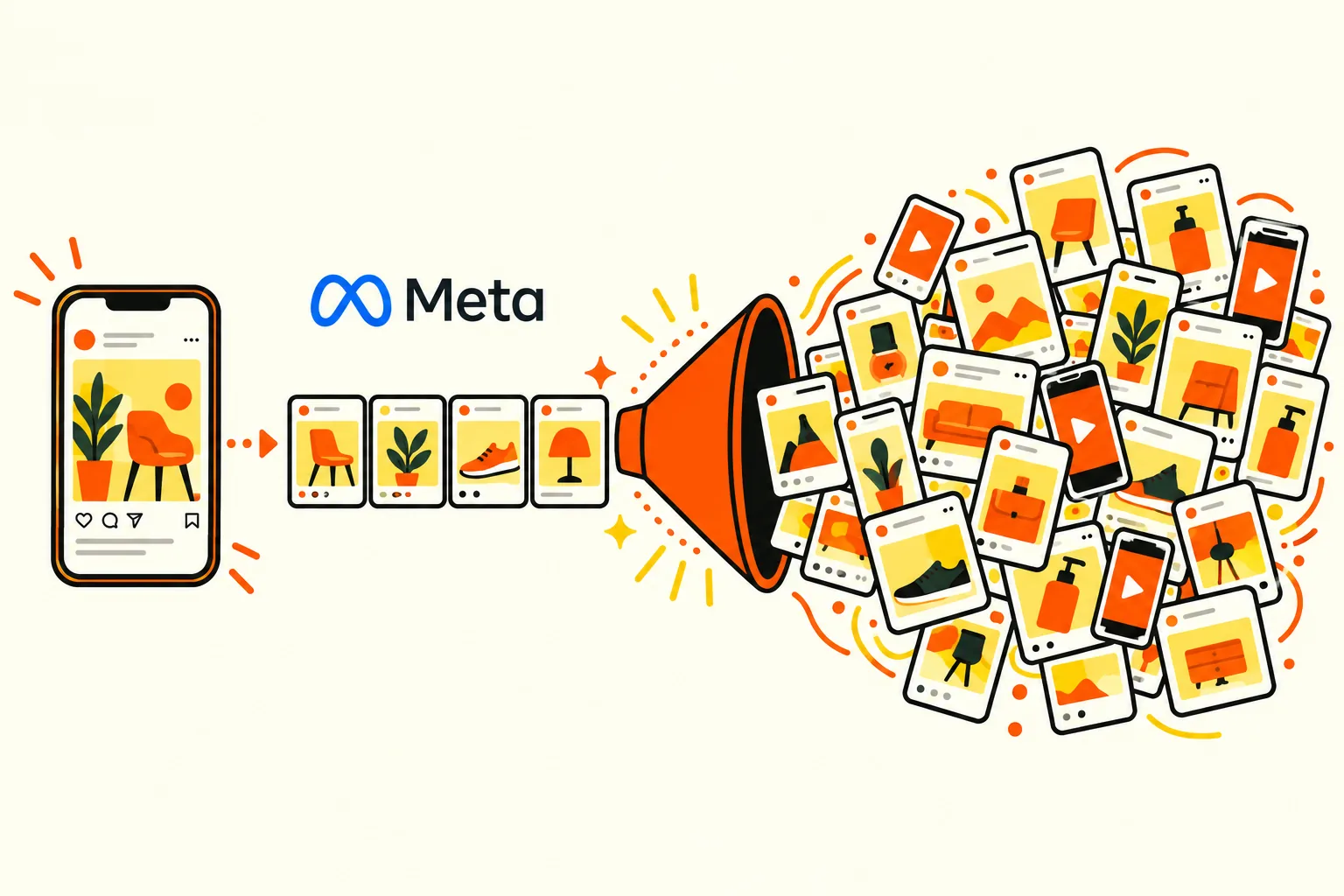
Meta ads run across Facebook, Instagram, Messenger and the Audience Network. For eCommerce, the Instagram and Facebook feeds and Reels are where most of the action happens.
The platform works on an auction. You don’t pay a flat rate: Meta shows your ad to the people most likely to take the action you asked for, based on relevance, bid and estimated action rates. Your job is to give Meta the right inputs, the creative, the audience and the offer, so it can find your buyers efficiently.
Meta optimises around signals
The data your Pixel and Conversions API send back about who actually converts.
And around creative
What’s in the ad itself. Increasingly the biggest lever you have.
02What is Andromeda? The biggest shift in Meta ads in a decade
If you’ve been running Meta ads for a while and noticed things stopped working the way they used to, this is why.
In December 2024 Meta announced Project Andromeda, a complete rebuild of the engine that decides which ads get shown to which people. By mid-2025 it had rolled out to most ad accounts globally. It isn’t a tweak. Meta’s own engineers describe it as a 10,000x increase in model complexity, at the exact stage where the system decides which ads even get a chance to compete.
How Andromeda actually works
Meta’s ad delivery now runs in two distinct stages.
Every eligible ad
Everything that could be shown to this person, in this placement, right now.
Stage 1 · Retrieval (Andromeda)
Before the auction begins, Andromeda reads your creative, not your targeting settings, and builds a “fingerprint” of the ad. It matches that fingerprint against each person’s behavioural signals in real time to decide whether your ad is even eligible to compete.
Stage 2 · Ranking (GEM + auction)
From the shortlist, Meta’s GEM system calculates expected value, predicted click-through rate, conversion probability, bid and placement context, and picks a winner.
What Andromeda reads in your ad
Visual content
Composition, colours, who’s on screen, product category cues.
Text
Tone, language style, problem framing, how the call to action is built.
Audio
Music genre, voiceover style, emotional tone.
Video structure
Hook format, pacing, completion signals.
The system builds a behavioural profile of who responds to this type of content and serves the ad to those people. Your creative is now your targeting.
What this changes for you
This is the mental-model shift that matters most. Under the old system you defined your audience and Meta found people who fit that definition. Under Andromeda, Meta reads your ad and finds people who behave like they’d respond to it, regardless of what audience you set. The practical implications:
- Detailed interest targeting matters far less. Andromeda’s behavioural matching already beats anything a manually built audience can define. Stacking interests is largely noise now.
- Lookalike audiences have lost their edge. The AI’s cross-platform signals are more sophisticated than what a 1% lookalike seed can produce. They still have some value for accounts with limited data, but they are no longer a primary strategy.
- Creative variety is how you scale now, not audience segmentation. The algorithm rewards accounts that supply diverse creative signals. Eight to twelve distinct creative concepts per campaign is the new benchmark.
- Creative quality drives more than half of campaign performance. The research Meta cites puts it at 56% of outcomes, more than targeting, budget, placement and bid strategy combined.
- Broad targeting with consolidated campaigns is the dominant approach. Fewer ad sets, larger budgets and wide targeting give Andromeda the room it needs to learn and optimise.
The new mental model
Stop thinking
“Who is my audience, and how do I reach them?”
Start thinking
“What creative signals will attract the right buyer, and am I giving Meta enough variety to find them?”
Your ads are no longer messages aimed at a defined group of people. They are signals you feed the algorithm so it can find people whose behaviour matches what your creative is about. The more distinct, high-quality signals you provide, the better Andromeda can work for you.

03Set up your foundation first
Before spending a dollar, get this infrastructure right.
Meta Pixel and the Conversions API
The Pixel tracks browser-side events; the Conversions API (CAPI) sends server-side data directly to Meta. Run both together. This is non-negotiable post-iOS 14: without strong signal your campaigns fly blind. Under Andromeda, clean and complete conversion data matters even more, because the AI’s optimisation is only as good as the signals it receives.
The events to track, in the order a customer fires them:
- PageView
- ViewContent
- AddToCart
- InitiateCheckout
- Purchase
Meta Business Manager
Everything lives here: the ad account, the Pixel, product catalogues, pages. Set it up properly with your business verified, and don’t run ads from a personal account.
Product catalogue
Connect your Shopify store through Meta Commerce Manager. This powers Dynamic Product Ads (DPA), which show each person the products they looked at.
04Campaign structure
Meta’s algorithm has become powerful enough that over-segmenting campaigns actively hurts performance. Andromeda needs consolidation to work: budgets fragmented across many ad sets stop it collecting enough signal to optimise.
The structure we recommend:
The rule
For eCommerce, always use the Sales objective with Purchase as the conversion event. Don’t use Traffic or Awareness. Ever.
Advantage+ sales campaigns
Under Andromeda, Advantage+ sales campaigns (what Meta used to call Advantage+ shopping, or ASC) are no longer just worth testing. For most eCommerce brands spending $100+ a day they should be the primary campaign type. Meta’s AI handles placement, audience and budget allocation automatically, and Advantage+ is built to work with Andromeda’s creative-matching logic. Meta’s own figure is a 22% higher return on ad spend for Advantage+ campaigns against business-as-usual campaigns, and in our experience the gap is widest for brands that feed them a diverse creative library.
05Audiences
The old playbook split every account into cold and warm: interest stacks and lookalikes for prospecting, then a ladder of retargeting ad sets for website visitors, add-to-carts and video viewers. Under Andromeda that structure works against you. It splits the budget into small pots and stops Meta learning from the whole account.
Today the default is broad. Set the country and an age floor if you need one, and let your creative and your conversion data find the buyers. Interests and lookalikes are now only optional “audience suggestions” Meta is free to go past, so we rarely use them at all.
Meta’s three audience segments
Instead of building audiences, you tell Meta who your customers already are. In your ad account settings you define two segments from your own data, and everyone else falls into the third:
- New audience
- Everyone who isn’t in the two segments below. People who’ve never bought and haven’t engaged. This is where growth comes from.
- Engaged audience
- People who know you but haven’t bought: website visitors, add-to-carts, Instagram and Facebook engagers, email subscribers. Defined by the custom audiences you choose.
- Existing customers
- People who’ve already bought, from your purchase events and customer list. Anyone in both lists counts as an existing customer.
These segments don’t restrict delivery. They tell Meta who’s who and let you break your results down by segment, so you can see exactly where the spend is going.
What happened to retargeting
It still happens, with less manual control. A broad sales campaign reaches your engaged audience and existing customers whenever Meta predicts they’ll buy, and catalogue ads show each of them the products they looked at. You don’t need a separate retargeting campaign for that.
How we run it
Set up all three segments, run broad, then check the audience segment breakdown every week. If too much spend is going to existing customers, cheap sales you’d mostly have made anyway, exclude them with a custom audience in your main prospecting campaign. Meta removed the old existing-customer budget cap in 2025, but custom audience exclusions are available again in Advantage+ sales campaigns.
06Creative: the most important variable
Post-Andromeda, creative is the primary targeting mechanism. The right creative self-selects its audience: Andromeda reads the ad and finds the people most likely to respond to it.
The algorithm loves creative diversity. Aim for 8–12 unique creative concepts per campaign, not slight variations of the same ad. Different hooks, formats, angles and styles each provide a distinct signal that helps Andromeda find a different buyer segment.
Ad formats that work for eCommerce
- UGC
- Customer-style videos shot on a phone. Authentic, low-production, high-trust, and usually the best performer: Andromeda reads the natural visual and audio cues as high-relevance signals.
- Demonstration
- Show the product solving a real problem. Before and after, how it works.
- Testimonials
- Real customers talking to camera. Specificity is everything: “I lost 6kg in 8 weeks” beats “I loved it.”
- Static images
- Don’t underestimate these. Clean product-on-background or lifestyle shots with bold text still convert.
- Carousels
- Good for showing a range or several features. Dynamic catalogue delivery pairs well here for personalised product recommendations.
- Reels and short video
- Vertical 9:16, hook in the first three seconds, made to feel native to the feed.
- Founder stories
- Build trust and emotional connection. They work well for challenger brands and premium products.
- Comparison ads
- “Us vs them” or “before vs after.” Strong for products with a real point of difference.
The hook is everything
Andromeda tracks hook hold rate, the share of viewers who watch past three seconds, as a key creative-quality signal. If the first three seconds don’t stop the scroll, the algorithm deprioritises your ad. Lead with curiosity, a bold claim, a problem statement or something visually unexpected.
Creative rotation schedule
Fatigue sets in fast at the top of the ad, so the hook turns over most often and the whole library least often.
| How often | What to rotate |
|---|---|
| Weekly | Swap hooks. Fatigue sets in fastest at the top of the ad. |
| Every two weeks | Rotate messaging angles and problem framings. |
| Monthly | Introduce new formats: new UGC talent, a new demo style, a new static concept. |
| Quarterly | A full creative overhaul based on performance data. |
Fatigue signals to watch
When you see any of these, swap creatives immediately. Don’t wait for the scheduled rotation.
07Copywriting framework
A proven structure for eCommerce ad copy, in order:
- Hook. Address the pain or the desire immediately.
- Agitate. Make the pain or desire more vivid.
- Solution. Introduce your product as the answer.
- Proof. Social proof, stats, reviews, before and after.
- Offer. What they get, plus any real urgency or scarcity.
- Call to action. Clear and direct. “Shop now.” “Get yours today.” “Claim 20% off.”
Keep primary text concise for mobile and lead with your strongest line: most people never expand “See more.” Andromeda reads your copy as a creative signal too, so the tone, the problem framing and the language style all inform who the algorithm shows your ad to.
08Offers and landing pages
Your ad gets the click. Your landing page closes the sale. The two must be congruent.
What makes a strong offer
- A clear value proposition above the fold
- Social proof: reviews, star ratings, customer count
- Risk reversal: money-back guarantee, free returns
- Urgency that’s real: limited stock, a sale deadline
- Fast load time. Every second of delay kills conversion rate.
Offers that lift ROAS
- A free-shipping threshold
- Bundle discounts
- Subscribe and save
- A first-order discount in exchange for an email
09Budgeting and bidding
Starting budget. A minimum of around $30–50 a day per ad set, so Meta has enough data to optimise. Too low and it stays in the learning phase indefinitely. Under Andromeda, consolidated budgets in fewer campaigns outperform fragmented micro-budgets every time.
Creative budget split
- 60% to proven, currently performing creatives
- 30% to testing new creative concepts
- 10% to seasonal or promotional content
Bidding strategy
- Highest volume
- The default (also called lowest cost). Good for starting out.
- Cost cap
- Set a maximum cost per purchase. Good for scaling once you know your numbers.
- Value optimisation
- With enough purchase data, optimise for the highest purchase value rather than the most purchases.
The learning phase
Each ad set needs around 50 conversion events within seven days to exit learning. Avoid significant edits during that window, because they reset the clock. Under Andromeda this matters even more: the system needs time to map your creative signals to the profiles of the people who convert.
CBO vs ABO
Campaign budget optimisation
Set the budget at campaign level and let Meta allocate it across ad sets. The preferred option under Andromeda.
Ad set budget optimisation
You control each ad set’s budget. Better for isolated creative testing.
10Scaling
Once you have a winning ad set, profitable and consistent, there are four ways to grow it.
Horizontal scaling
Duplicate the winning ad set three to five times with different creative variations. Not slight tweaks: genuinely new concepts. Different hooks, formats and angles give Andromeda new signals to work with.
Vertical scaling
Increase the budget by no more than 20–30% every two to three days, so you don’t trigger a learning-phase reset.
Broad plus high budget
At scale, broad audiences with high daily budgets and a diverse creative library consistently beat everything else. Meta has the data. Give it room to find buyers.
Advantage+ at scale
Once you’ve proven profitability, move the primary budget into Advantage+ sales campaigns. Feed them your full creative library and let Andromeda do the heavy lifting on audience and placement.
11Key metrics to track
| Metric | What it tells you | Benchmark |
|---|---|---|
| CTR (link) | Is your creative stopping the scroll? | 1–3%+ |
| Hook hold rate (0–3s) | Is your hook working? | 40%+ |
| CPC | The cost efficiency of your traffic | Depends on niche |
| CPM | How competitive your audience is | Watch the trend |
| Add-to-cart rate | Is your landing page engaging? | 5–10%+ |
| Purchase conversion rate | Is your offer and checkout converting? | 2–5%+ |
| ROAS | Campaign-level profitability | 2–4x minimum |
| MER | Total revenue ÷ total ad spend. Account-level health. | Know your target |
| CPA | Cost per acquisition | Below your margin |
| Frequency | Your ad-fatigue indicator | Watch above 4–5 |
Know your break-even ROAS before you start. If your gross margin is 50%, you need at least 2x ROAS just to cover ad spend. Our ROAS calculator works it out from your own margins.
A note on MER
Post-Andromeda, campaign-level attribution has become fuzzier, because the AI spreads ads across placements in ways that are harder to track one by one. Marketing efficiency ratio, total revenue divided by total ad spend across every channel, gives a cleaner picture of overall account health. Watch it at the account level, not just by campaign. The MER calculator gives you the break-even and target figures.
12Common mistakes to avoid
- Touching campaigns too often. Constant edits reset the learning phase. Review weekly, not daily.
- Too many ad sets at low budgets. Andromeda needs consolidated spend to learn. Fragmentation is one of the biggest performance killers post-update.
- Running the same creative too long. Fatigue hits faster now. Watch hook hold rate and CTR, and rotate before the metrics crater, not after.
- Sending traffic to your homepage. Always send people to the product or collection page the ad was about.
- Optimising for the wrong event. If you aren’t getting enough purchases, optimise for AddToCart temporarily and switch once the data builds.
- Not using the Conversions API. Without server-side data you lose signal, and your Andromeda optimisation suffers: the AI can only be as good as the conversion data you feed it.
- Relying on detailed interest targeting. Stacking interests is largely redundant now. Your creative does the targeting, so put the energy into creative production instead.
- Only running two or three creatives. Under Andromeda, creative diversity is the strategy. Too few concepts limits what the algorithm can learn and who it can find for you.

13Quick-start checklist
Run your own account against these twelve before you scale anything. Your ticks are saved on this device.

0 of 12 done

Thanks for reading, and I hope that helps. If you want a second pair of eyes on your own account, that’s what the call is for.
Sam Despo
Founder & Director, Pulp Digital