01What a hook actually is
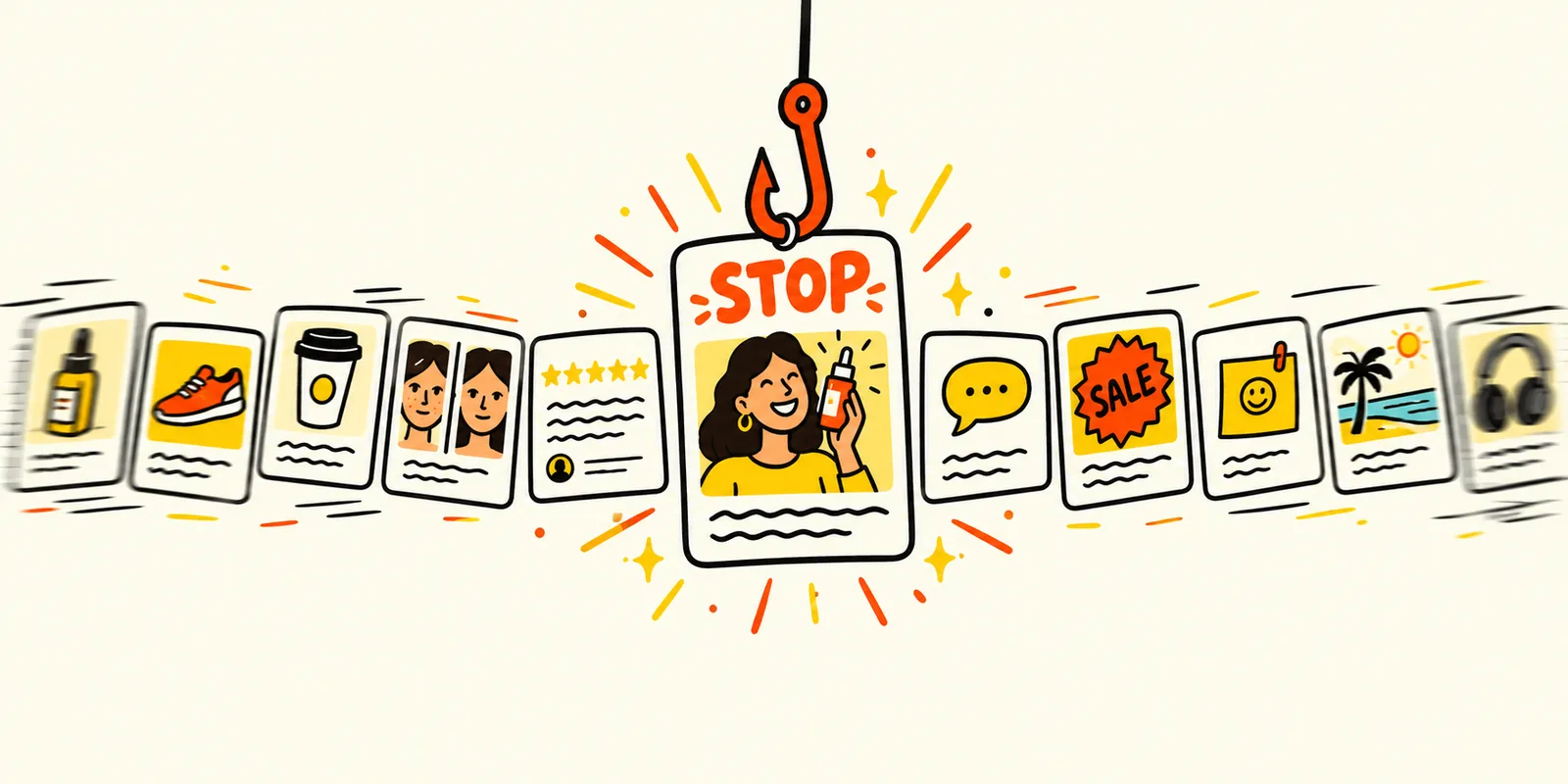
The hook is the part of an ad someone takes in before they decide whether to keep scrolling. On a video, that’s roughly the first one to three seconds. On a static, it’s the headline and the image, read together in about the same time.
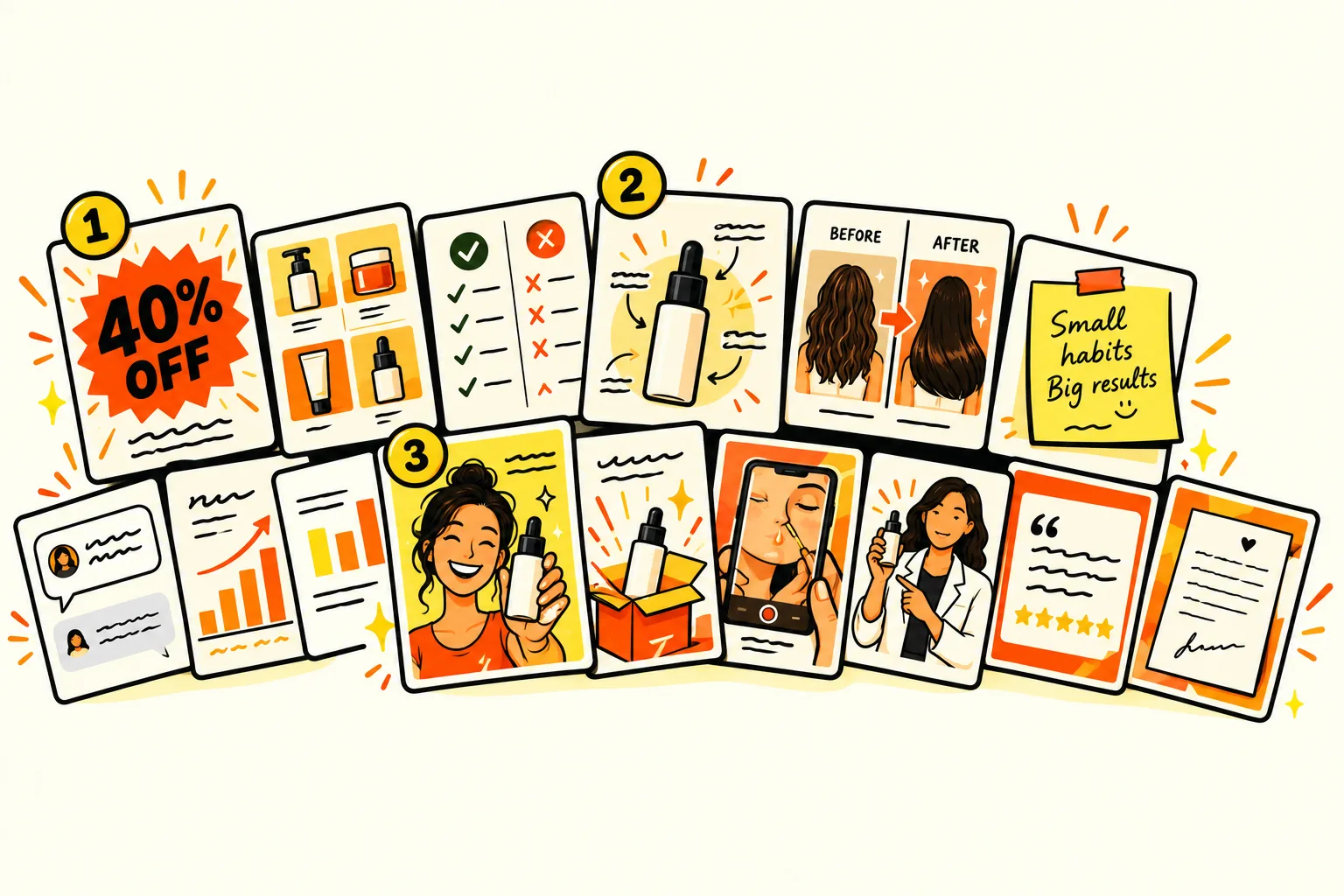
Most people think of the hook as a line of copy, but it’s made of three layers that land at once.
The best hooks have all three saying the same thing. A strong line over a dull opening frame loses people before they read it, and a striking visual with a vague line stops people who have no reason to stay.
A hook has one job: get the right person to stop and want the next sentence. Not everyone. The right person.
02How Meta reads your hook
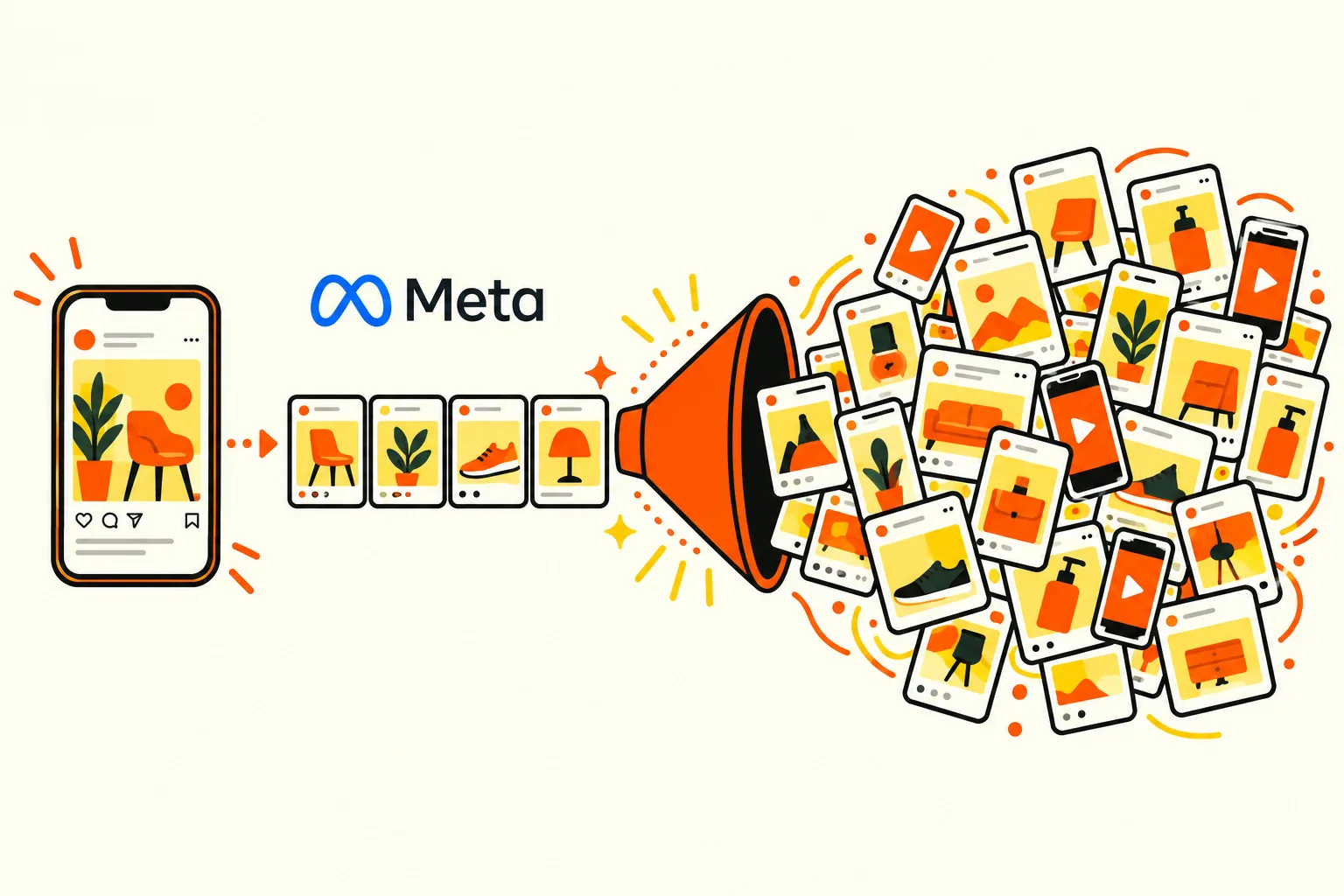
Meta used to rely on the audiences you picked. Now the ad itself does most of the targeting, and the hook is the loudest part of the ad. Two systems decide whether yours gets seen.
- Andromeda shortlists. Every time someone opens Instagram or Facebook, Andromeda narrows tens of millions of possible ads down to a few thousand. It does that by reading what’s in each creative, the visuals, the words and the format, and matching it to what each person tends to respond to. If your ad doesn’t clearly look like it’s for someone, it doesn’t make the shortlist for anyone.
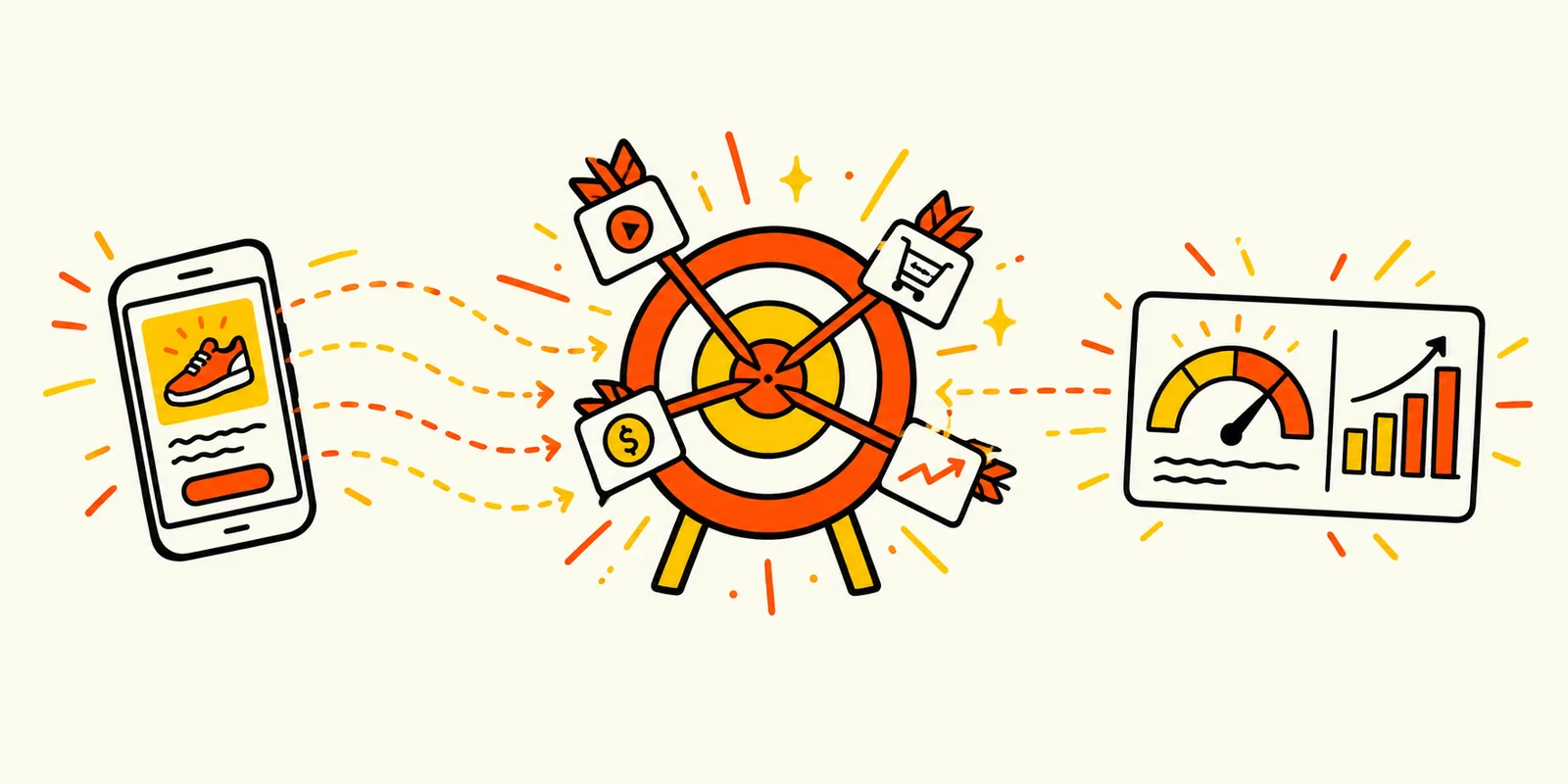
- Ranking picks the winner. From that shortlist, Meta’s ranking models predict who will stop, click and buy, and they learn from the creative itself as well as from how people react to it. Every time the right person stops on your hook, the system gets better at finding more people like them.
Three things follow from that, and they shape everything else in this guide.
The hook is your targeting
A hook that names a specific person and problem tells Meta exactly who to find. A vague or shocking one stops the wrong people, and Meta learns from them instead.
Lookalike ads count as one
Meta treats near-identical ads as the same ad. Ten versions with new colours are one idea. Five genuinely different hooks are five ways in, and each can reach a different group of buyers.
Third, and most important
A hook only works if the ad behind it delivers. Meta ranks on what people do after they stop, not just whether they stop. A hook that wins attention and loses the sale gets pushed down.
Our Meta ads guide covers Andromeda and how to structure an account around it in more detail.
03One hook for each job
Someone seeing your brand for the first time and someone who has had your product in their cart for a week need completely different openings. We group hooks by the job they do best.
Discover · People who don’t know you
They aren’t looking for you and may not know they have the problem. The hook has to earn attention by being about them, not about you.
Nurture · People weighing it up
They know the problem and they’ve seen you, maybe a few times. The hook has to give them a reason to believe you over the alternatives.
Convert · People ready to buy
They want it. The hook has to give them a reason to buy now rather than later.
That doesn’t mean building a separate campaign for each stage. We run most of our clients’ ads in one broad campaign and let the hooks do the sorting. A discovery hook tells Meta the ad is for newcomers, an offer hook tells it the ad is for people who are close. The account works best when every stage has fresh hooks in it.
Here are all fifteen at a glance. Jump to any of them.
| Hook | Job | Why it resonates |
|---|---|---|
| 01 The callout | Discover | People stop for themselves |
| 02 The problem | Discover | Feeling understood |
| 03 The visual interrupt | Discover | The eye goes to the unexpected |
| 04 The contrarian | Discover | We stop to check if we’re wrong |
| 05 The confession | Discover | Honesty doesn’t read like an ad |
| 06 The open loop | Discover | An unanswered question nags |
| 07 Result first | Nurture | Proof before the pitch |
| 08 Proof in numbers | Nurture | Other people went first |
| 09 Borrowed authority | Nurture | Trust transfers from the expert |
| 10 The comparison | Nurture | Contrast makes the choice easy |
| 11 The objection | Nurture | It asks their question for them |
| 12 The offer | Convert | There’s nothing to work out |
| 13 The price anchor | Convert | The price feels smaller |
| 14 The new drop | Convert | A fresh reason to look again |
| 15 Real urgency | Convert | Nobody likes missing out |
04Eight habits of a good hook
Whatever the hook, these are the habits we check every one against.
- Lead with the payoff. Put the most interesting thing first: the result, the claim, the problem. Logos, brand intros and “hey guys” come later or not at all.
- Make it work with the sound off. If the hook only lands when you hear it, most people never get it. Put the line on screen, big, from the first frame.
- Move in the first frame. On video, start mid-action. A still opening frame looks like a photo, and people scroll past photos.
- Use your customers’ words. Reviews, comments and support emails are full of hooks. “My feet hurt by lunchtime” beats anything a copywriter invents about comfort.
- Say one thing. One idea per hook. If it needs a second line to make sense, rewrite the first one.
- Match it to the job. Pick the stage first, then the hook. A discount is wasted on someone who has never heard of you, and a curiosity hook is wasted on someone ready to buy.
- Keep the promise. The next five seconds have to deliver what the hook offered. Meta ranks on what happens after the stop.
- Keep it out of the way. In 9:16, keep text clear of the top and bottom of the frame, where Instagram and Facebook put their own buttons and captions. Check it in the Ads Manager preview before you launch.
05Hooks that get you discovered
Six hooks for people who have never heard of you. Their job is to earn attention from a stranger, and to make it obvious to Meta who the ad is for. Every one works on a static as well as a video.
01The callout
What it is. The ad names who it’s for in the first line. “If you’ve got curly hair…”, “For runners over 40”, “If you work on your feet all day”.
Why it resonates. We all filter the feed for things that are about us. The moment someone recognises themselves, the ad stops being an ad and becomes advice for them. Everyone else scrolls on, which is exactly what you want: the callout is the clearest signal you can send Meta about who to find next.
How to use it
- Call out a situation, not just a demographic. “If you work on your feet all day” is sharper than “Calling all nurses”.
- Write one callout per type of buyer you sell to, and run them as separate ads.
- Don’t assert personal traits Meta won’t allow, like health conditions, finances or body image. “Are you overweight?” gets rejected. “For anyone getting back into running” doesn’t.
Lines to try
“If you’ve tried every [product] and still [problem], read this.”
“For anyone who [specific situation].”
“[Audience], you’re going to want to see this.”
02The problem
What it is. The ad opens on the frustration the product fixes, in the words a customer would use. “My sheets are sticky by 2am”, or a video that opens on the coffee going cold again.
Why it resonates. People notice their problems long before they notice products. A problem said exactly the way they’d say it makes them feel understood, and once they’ve nodded along to the first line, they want to see the fix. It also reaches people who would never search for your product because they don’t know a solution exists.
How to use it
- Take the problem straight from your reviews. Look for the line before “and then I found…”.
- Be specific. “Bad sleep” is a category. “Waking at 3am too hot to get back to sleep” is a hook.
- Show the problem rather than just saying it: the tangled cable, the faded shirt, the wet sock.
- Get to the fix quickly. Dwell on the problem too long and the ad becomes a lecture.
Lines to try
“Tired of [problem in the customer’s words]?”
“POV: it’s [time] and [problem] again.”
“Why does [everyday thing] always [annoying result]?”
03The visual interrupt
What it is. The image does the hooking. Something the eye doesn’t expect: the product being crushed, poured, dropped or stretched, an odd angle, an extreme close-up, or a still that doesn’t look like an ad at all.
Why it resonates. The eye reacts to surprise before the brain reads a word. A frame that breaks the rhythm of the feed buys the half-second you need for the copy to land. When the surprise is the product itself, it also shows something real about it, which a stranger has no other reason to believe yet.
How to use it
- Make the surprising thing the product. A random explosion stops people. A suitcase surviving a fall stops buyers.
- Pair it with a line that explains the image, or the stop is wasted.
- On a static, use scale and contrast: a huge product, an empty background, a colour no one else in your category uses.
Lines to try
“We tried to break it.”
“This is what [amount] of [ingredient] looks like.”
“Satisfying, but also [benefit].”
04The contrarian
What it is. The ad says something that goes against what the viewer believes, busts a common myth or gives a warning. “Stop washing your hair every day”, “Your expensive serum is the problem”, “Don’t buy a mattress until you’ve read this”.
Why it resonates. Being told we might be wrong is uncomfortable, so we stop to check. A warning works the same way: people are more motivated to avoid a mistake than to gain a benefit. And a brand that challenges the category’s usual advice comes across as the one that knows better, which is a strong place to sell from.
How to use it
- Only say it if you can back it up in the next few seconds. A contrarian line with no proof looks like clickbait.
- Challenge a habit or a belief, never the customer. “You’ve been doing it wrong” can work. Making them feel stupid won’t.
- Check the claim with whoever signs off your marketing, especially in health and skincare.
Lines to try
“Stop [common habit]. Do this instead.”
“[Popular advice] is why your [problem] isn’t going away.”
“Don’t buy a [product] until you know this.”
05The confession
What it is. The ad opens with an honest admission, told in the first person by a founder or a customer. “I’ll be honest, I hated running”, “We got our first batch completely wrong”, “I didn’t believe it would work either”.
Why it resonates. Ads don’t admit things, so a confession doesn’t read like one. It sounds like a person talking, which lowers the viewer’s guard. Admitting a flaw or a doubt also makes everything said after it more believable, and once we’re in a story we want to know how it ends.
How to use it
- Make the confession real and specific. Invented vulnerability is easy to spot.
- Start at the moment of tension. Skip “Hi, I’m…” and open on the admission.
- Match it to your brand’s voice. It suits founder-led and wellness brands better than, say, financial products.
- Land on the product quickly, as the thing that changed the story.
Lines to try
“I’ll be honest, I [doubt or bad habit].”
“I started [brand] after [specific moment].”
“Our first [product] was a disaster. Here’s what we changed.”
06The open loop
What it is. The ad raises a question and doesn’t answer it straight away. “The one thing every good night’s sleep has in common”, “3 things I wish I knew before buying a pram”.
Why it resonates. An unanswered question is mildly uncomfortable, so people keep watching or reading to close it. Done well, it carries them straight through to the product, and the product feels like the answer they found rather than a pitch they were given.
How to use it
- Keep the loop short. Answer it within five to ten seconds, or in the first line of the primary text.
- Make the answer the product, or something the product does.
- Be specific, not vague. “You won’t believe this” gives no reason to care. “The ingredient most moisturisers leave out” does.
Lines to try
“The reason your [thing] [problem] isn’t what you think.”
“3 things I wish I knew before buying a [product].”
“What [experts] do differently with [everyday task].”
06Hooks that build trust
Five hooks for people who know the problem and have probably seen you before. They’re not short of interest. They’re short of belief, so these hooks lead with proof.
07Result first
What it is. The ad starts at the end: the clean oven, the finished room, the skin after six weeks. Then it goes back and shows how.
Why it resonates. Someone weighing up a purchase wants one question answered: does it actually work? Seeing the result answers it before they’ve finished asking. Most ads save the result for last, by which time the viewer has gone. Put it first and the rest of the ad becomes the explanation they now want.
How to use it
- Open on the most satisfying frame you have, then cut back to the start.
- On a static, make the result the image and let the headline say how long it took.
- Use a real result, and follow Meta’s rules on before-and-after images for bodies, weight and health.
Lines to try
“This took [short time]. Here’s how.”
“Day 1 vs day 30.”
“Same [thing], [time] apart.”
08Proof in numbers
What it is. The ad opens with a number that proves other people already trust the product. “40,000 Aussies sleep on this”, “Sold out three times this year”, “4.8 stars from 6,000 reviews”.
Why it resonates. When we’re unsure, we look at what other people did. A big, specific number does the convincing before doubt sets in, and an exact figure like 6,214 feels more honest than a round one. For someone who has seen you before but held back, it’s the reassurance that they wouldn’t be the first.
How to use it
- Use a number that’s true and that you can show the working for.
- Pick the number that means most to the buyer: customers, reviews, repeat orders, a waitlist.
- Make the number the biggest thing on the canvas.
Lines to try
“[Number] people switched to [product] this year.”
“Why [number] [audience] won’t go back to [old way].”
“Rated [score] by [number] customers. Here’s why.”
09Borrowed authority
What it is. The ad opens with someone whose job makes them worth listening to. “I’m a physio, and this is the one thing I’d buy”, “A chef’s honest take on non-stick pans”, or your own formulator explaining an ingredient.
Why it resonates. In crowded categories, buyers have stopped believing brand claims. They still believe people with expertise, and that trust carries over to the product. An insider’s view also feels like a shortcut: someone who knows has already done the research for you.
How to use it
- Show the credential in the first frame: the title, the uniform, the workplace.
- Let them explain why it works, not just say that it does.
- Check your category’s rules first. Health and therapeutic claims are tightly limited in Australia.
Lines to try
“I’m a [profession]. Here’s what I actually use.”
“What a [expert] looks for in a [product].”
“Our [maker or formulator] explains why we [unusual choice].”
10The comparison
What it is. The ad sets your product against the alternative in the first second. Not a named competitor, but the category or the old way: “Regular deodorant vs ours”, “The gym vs 10 minutes at home”, “Fast fashion vs a shirt that lasts”.
Why it resonates. Someone weighing options is already making a comparison in their head. Doing it for them saves effort, and putting the two side by side lets the contrast do the persuading. You also get to choose which differences matter.
How to use it
- Compare against a category or a habit, not a named brand.
- Pick the three or four differences the buyer cares about, not every feature.
- Make every claim one you can back up. Meta and your competitors both look closely at comparisons.
Lines to try
“[Old way] vs [your product]: the difference after [time].”
“What you get from [typical option] vs what you get from us.”
“Why we stopped [category habit].”
11The objection
What it is. The ad opens with the doubt the buyer already has, and answers it. “Is it actually worth $89?”, “Does it work on thick hair?”, “Why is it so expensive?”.
Why it resonates. People who already know you aren’t held back by a lack of interest. They’re held back by one question. Asking it out loud shows you aren’t hiding from it, and answering it removes the last reason to wait. Asked as a real comment from a real customer, it also proves other people wondered the same thing.
How to use it
- Find the objection in your comments, DMs and support tickets, not in a brainstorm.
- Answer it honestly and early. The answer is the ad.
- Run one ad per objection: price, fit, results, delivery, returns.
Lines to try
“‘Is [product] actually worth it?’ Honest answer:”
“You asked why it costs [price]. Here’s why.”
“Does [product] work if [doubt]? We tested it.”
07Hooks that close the sale
Four hooks for people who already want the product. These are the ones that win most often in sale periods, and the ones that do the most damage when the offer or the deadline isn’t real.
12The offer
What it is. The deal is the hook. “Free gift with every order this week”, “Buy 2, get 1 free”, “30-night trial”.
Why it resonates. For someone already thinking about buying, a clear offer is the strongest hook there is, because there’s nothing to interpret. It turns “one day” into “today”. A guarantee or a trial works the same way by taking the risk out of saying yes.
How to use it
- Only use it when there’s a real offer. Constant discounts train customers to wait for the next sale.
- One offer per ad, in the fewest words possible.
- Remember the offer can be a guarantee, a bundle, a trial or free shipping, not just a discount. Those protect your margin.
Lines to try
“[Offer]. Ends [day].”
“Try it for [time]. Don’t love it? Send it back.”
“Free [bonus] with every [product] this week.”
13The price anchor
What it is. The ad puts your price next to a bigger number so it feels small. “$300 at the salon, $39 at home”, “Less than a coffee a week”, “Was $129, now $89”.
Why it resonates. We judge a price by what we compare it to, not on its own. Give people a higher reference point first and the real price feels like a good decision. Breaking it into a daily or weekly cost does the same thing, turning one big decision into a small, everyday one.
How to use it
- Use an honest anchor: a real past price, a real alternative or real maths.
- Pick the comparison your buyer already pays for, like the salon, the takeaway or the replacement.
- Make both numbers big and easy to read in a second.
Lines to try
“[Alternative] costs [high price]. This costs [your price].”
“Less than [everyday purchase] a [day or week].”
“It pays for itself after [number] [uses].”
14The new drop
What it is. The ad leads with something new: a launch, a new colour or flavour, a restock or a limited edition. “Just dropped”, “It’s back”, “New: the travel size”.
Why it resonates. Novelty gets noticed, even by people who have scrolled past you a dozen times. A launch gives anyone who was on the fence a fresh reason to look again, and a restock says other people wanted it badly enough to sell it out. It’s one of the most dependable hooks we use with people who already know the brand.
How to use it
- Plan launches and restocks as ad moments, with hooks written before the drop.
- Show the new thing in the first frame, not the brand.
- Say what’s new in plain words. “New” on its own is not a reason.
Lines to try
“Just dropped: [new product or colour].”
“It sold out in [time]. It’s back.”
“You asked for [feature]. We made it.”
15Real urgency
What it is. The ad leads with a real reason to act now: a sale ending, limited stock, the last day to order before Christmas. “Ends midnight”, “Only 200 made”, “Last day for Christmas delivery”.
Why it resonates. Missing out stings more than gaining something feels good, so a deadline moves people who would otherwise put it off. It works best on people who already want the product, because it doesn’t create desire, it only brings the decision forward.
How to use it
- Only use a deadline or a limit that’s true. Fake urgency is easy to spot and erodes trust in every ad after it.
- Be exact: a day and a time, or a number left.
- Swap the creative as the deadline gets closer: “3 days left”, then “Last day”.
Lines to try
“[Offer] ends [day] at midnight.”
“Last day to order for [event] delivery.”
“We made [number]. [Number] are left.”
08Hooks that backfire
A bad hook doesn’t just get ignored. On Meta it can teach the system to find the wrong people. These are the ones we see most often.
- The bait and switch
- A hook the ad doesn’t pay off. It gets the views, then clicks and sales fall away, and Meta learns that the people who stopped don’t buy.
- The slow start
- A logo, a brand intro or two seconds of scenery before anything happens. Most of the people who’d have stopped have already gone.
- Shock for its own sake
- Loud, strange or shocking openings that have nothing to do with the product. They stop everyone, which means they stop the wrong people too.
- The wrong job
- A discount shown to strangers, or a curiosity hook shown to people ready to buy. The hook is fine, but it’s talking to the wrong stage.
- The lookalike hook
- The same opening with a new colour or font. Meta treats it as the same ad. Change the idea, not the paint.
- Fake urgency
- Countdowns that reset and “last chance” sales that never end. People notice, and they stop believing the real ones.
- Breaking the rules
- Hooks that assert someone’s health, weight, finances or other personal traits, or promise results you can’t prove. They get rejected, or approved and then flagged later.
09How to test a hook
You won’t know which hook works until you run it. The good news is that hooks are the cheapest part of an ad to test, because the rest of the ad can stay exactly the same.
What to measure
| Metric | How it’s worked out | What it tells you |
|---|---|---|
| Hook rate | 3-second video plays ÷ impressions | Whether the opening stops people. The main hook metric for video, and most useful for discovery hooks. |
| Hold rate | ThruPlays ÷ 3-second video plays | Whether the ad keeps the people the hook stopped. A high hook rate with a low hold rate usually means the hook over-promised. |
| Link click-through rate | Link clicks ÷ impressions | The best hook signal for statics, which have no video plays. |
| Cost per purchase | Spend ÷ purchases | The one that decides, at every stage. A hook that stops fewer people but sells more is the better hook. |
What we aim for
Meta doesn’t publish a benchmark, and it varies a lot by category and placement (Reels usually runs higher than Feed). As a working guide on new audiences, we treat a hook rate of 25% as the baseline and aim for 40% or more. Below 25%, the opening isn’t doing its job. Use those numbers to compare hooks against each other, not as a pass mark. Expect conversion hooks to show lower hook rates and better cost per purchase: that’s them doing their job.
How to run the test
- Keep the body, change the opening. Cut three to five versions of the same ad with different first seconds, or the same static with different headlines.
- Make the hooks genuinely different. Test a callout against a problem against a result, not three wordings of the same callout. Near-copies are one ad to Meta.
- Cover every job. Make sure the account always has fresh discovery, trust and conversion hooks running, not fifteen of one kind.
- Launch each as its own ad in the same ad set, so Meta can spend toward the one that works.
- Give it enough spend to judge. Hook rate settles quickly. Cost per purchase needs more data, so don’t call a winner on a day’s results.
- Take the winner further. A winning hook is a winning idea. Move it into other formats: a headline static, a founder video, a comment reply.
For how many ads to make each month at your budget, use our Meta ad creative calculator. For which formats to put your hooks in, see the 15 best ad creatives to run in 2026.
10Hook checklist
Check each hook against these before it goes live. Your ticks are saved on this device.

0 of 10 done

Thanks for reading. Every line on this page is a starting point: the best hooks always come from your own customers, so fill in the blanks with their words. If you’d like hooks like these written and built into static ads for your brand, that’s what our ad creative service does. And if you want a second opinion on what you’re running now, book a call.
Sam Despo
Founder & Director, Pulp Digital